A family holiday with a radio station in the luggage
This year’s family holiday on the beautiful island of Hvar once again included a small but fully operational amateur radio station. What was primarily a family vacation turned into 15 days of enjoyable operating whenever time, propagation and family duties allowed.
From Hvar (EU-016), I made 1,516 QSOs with 94 different DXCC entities, operating across nine bands and using three modes: SSB, FT8 and FT4.
The radio was not running continuously. In fact, most operating sessions were relatively short and fitted around the family schedule. With a two-year-old daughter enjoying her holidays as well, FT8 and FT4 were often the practical choice – especially during nap time, when a 100 W SSB signal would have been considerably less welcome than a quiet digital session. 😊
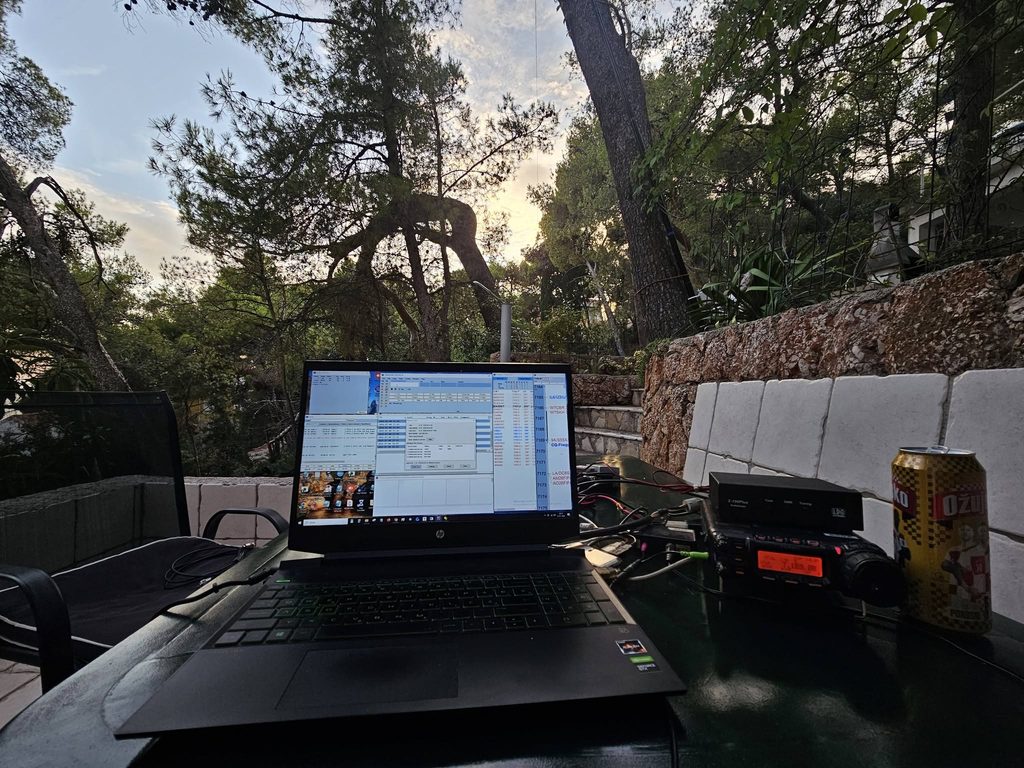
The holiday shack
The station was built around a Yaesu FT-857D, running up to 100 W on SSB and approximately 20–30 W on FT8 and FT4.
The complete setup consisted of:
- Yaesu FT-857D
- microHAM USB Interface II
- additional external USB sound card
- homebrew EFHW antenna
- LDG AT-100 Pro tuner
- N1MM+
- MSHV
- WSJT-X
- Log4OM v2
The EFHW was installed with approximately 5 metres in the vertical section and another 16.2 metres sloping downwards, with the antenna oriented approximately east–west.
Fortunately, there was plenty of space next to the apartment for the installation. Before arriving, I contacted the apartment owner and informed them about my plans to install an amateur radio antenna. After checking with them, I received permission and there were no objections to the setup.
That made the whole operation considerably easier – there was enough room to deploy the antenna properly while keeping the installation relatively simple and unobtrusive.
Nine bands and three modes
During the stay I was active on:
80 m · 40 m · 30 m · 20 m · 17 m · 15 m · 12 m · 10 m · 6 m
Most of the bands were covered directly by the EFHW, while the tuner helped where necessary.
The activity was split between SSB, FT8 and FT4. Digital modes once again accounted for the majority of QSOs, largely because they allowed me to operate during short periods of free time without disturbing the rest of the family.
SSB, however, was still very much part of the operation, especially when conditions were good and there was enough time for a proper operating session.
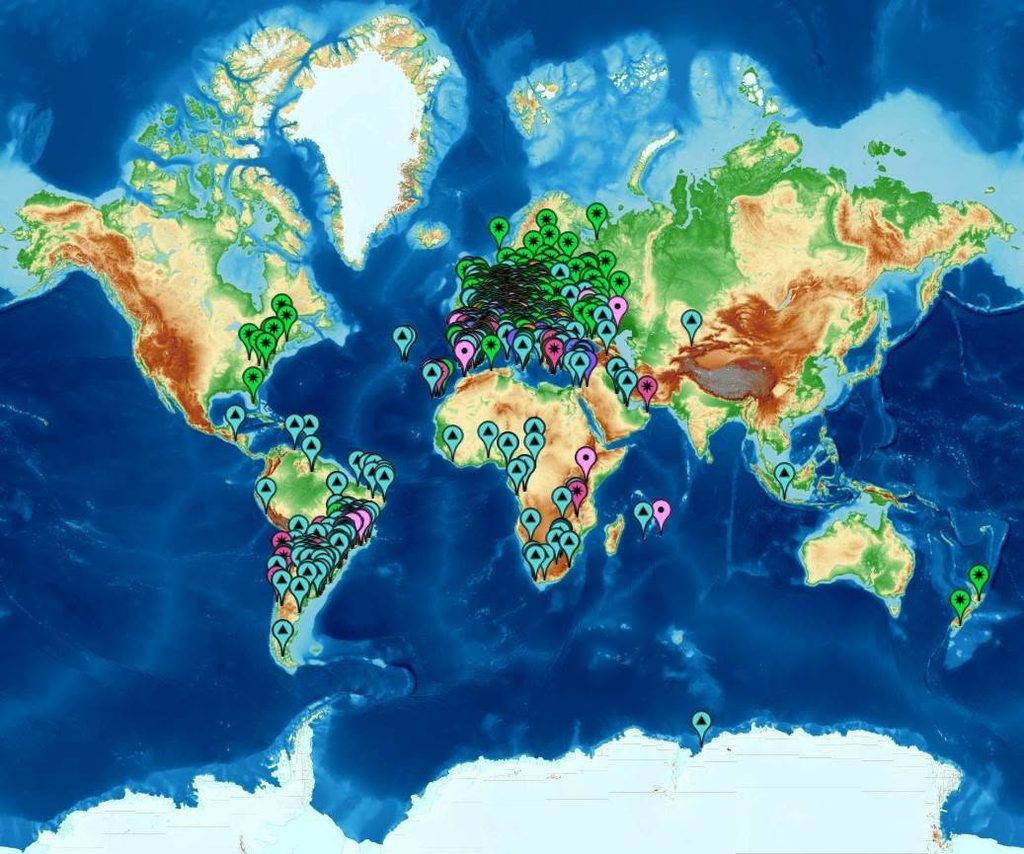
Excellent conditions towards Africa and South America
One of the highlights of the activation was the propagation towards Africa and South America.
The 40 m and 15 m bands produced particularly good activity, and the log contains a surprisingly large number of African DXCC entities – including some that I do not often work during my normal activity from home.
Propagation towards South America was also excellent. For the first time in my activities, a genuine DX entity made it into my Top 5 worked DXCCs during an activation. This time it was Brazil.
Another particularly interesting contact in the log was a QSO with Antarctica. 🌍📡
For a relatively modest holiday station using a homebrew EFHW, these were some of the most enjoyable moments of the operation.
The downside – 20 metres
Not everything was perfect.
The biggest problem was QRM on 14 MHz (20 m). The interference was present during practically the entire stay, with the exception of the SOTA activation.
The noise level was high enough that only the strongest signals could be copied reliably. This made 20 m considerably less useful than expected and forced me to spend more time on other bands.
The location also had a geographical limitation. Looking towards approximately 300°–60°, the horizon was blocked by a mountain roughly 1 km away and around 600 metres higher than the operating location.
Despite this, the remaining directions were open enough to provide excellent opportunities for DX.
Taking the radio to the summit
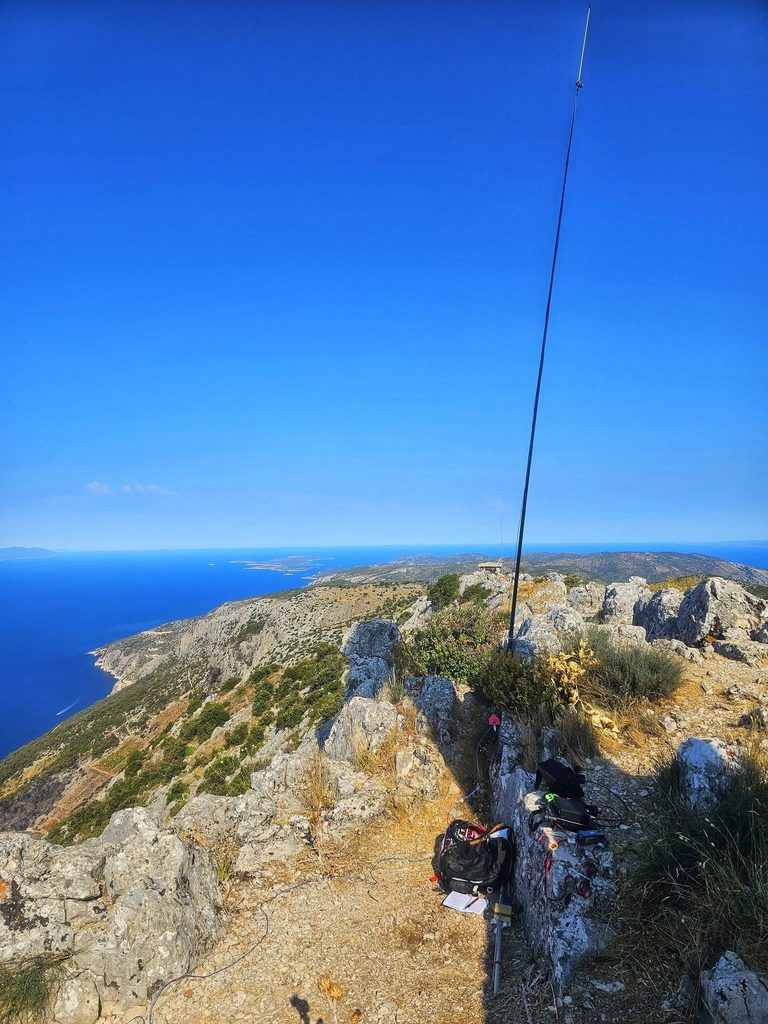
The holiday operation also included a SOTA activation of Sveta Nikola – 9A/DH-086.
The summit provided a completely different operating environment. Instead of the holiday shack next to the apartment, the station was carried to the top of the mountain, where the reward was not only the radio activity but also an incredible operating location overlooking Hvar Island, the Pakleni Islands and the other islands of Central Dalmatia.
The summit activation was another reminder of why portable amateur radio is so enjoyable – a relatively small amount of equipment can turn almost any suitable location into a temporary shack.
References activated from Hvar
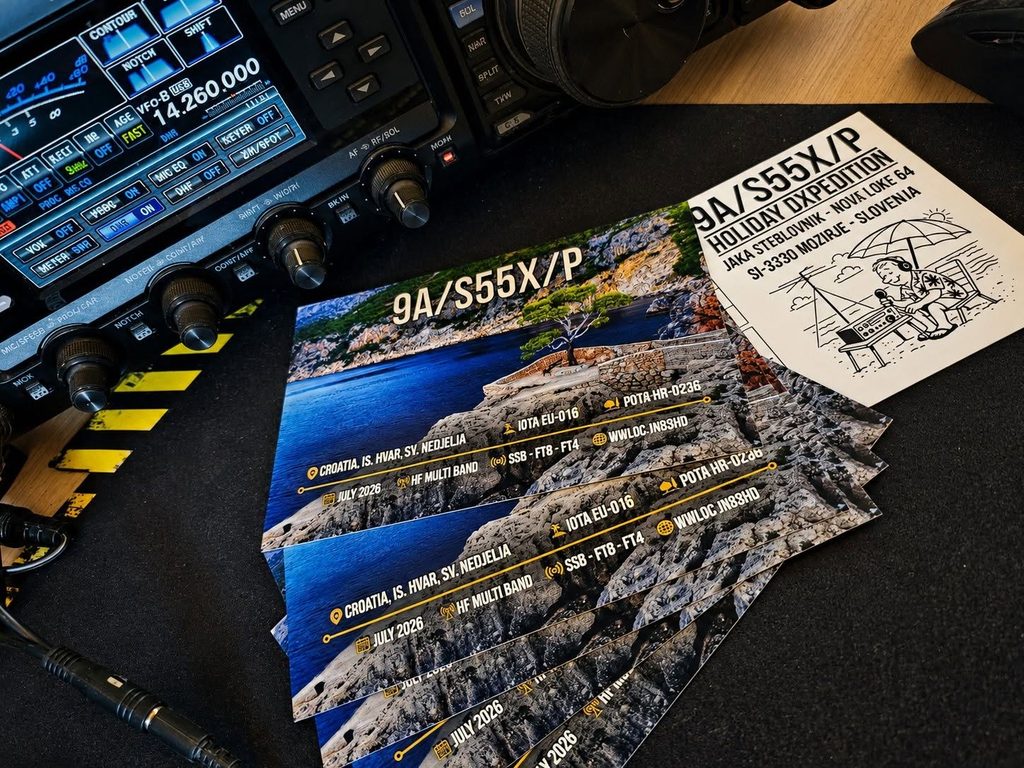
During the holiday I was able to combine several amateur radio activities and references:
- IOTA: EU-016 – Hvar Island
- SOTA: 9A/DH-086 – Sveta Nikola
- POTA: HR-0236
- IOCA: CI-028
- WW Locator: JN83HD
This combination made the activity particularly interesting, as the same holiday location offered opportunities for several different types of portable operating.
1,516 QSOs later…
After 15 days, the final log contained:
1,516 QSOs
94 DXCC entities
9 bands
3 modes
For me, however, the numbers are only part of the story.
This was first and foremost a family holiday, not a DXpedition. The radio had to fit around family time, trips, swimming, meals, naps and everything else that comes with travelling with a young child.
I simply took advantage of every opportunity when I could sit down at the station and make a few QSOs.
And that is probably what I enjoy most about taking amateur radio on holiday: it doesn’t have to be a full-time operation. A few minutes at the radio can produce a handful of QSOs, a new DXCC, an unexpected band opening or a memorable contact thousands of kilometres away.
The HF equipment will therefore almost certainly be coming along again on the next family holiday. 📡🌴
Thanks to everyone who called, spotted and worked me from Hvar!
0 Comments